Portfolio Examples · Business Analyst Portfolio
Business Analyst Portfolio Example: Four Case Studies That Prove Impact (2026)
The business analyst portfolios that get interviews are short: three to five case studies that each say what the business needed, which options were on the table, what you personally owned and what changed, plus at least one document the reader can open themselves. Below is a complete sample portfolio built on that pattern, taken apart section by section so you can borrow the structure.
It is for working BAs lining up a move, analysts applying for a first BA job, and operations, testing or project people crossing into analysis. The portfolio belongs to Marta Kowalczyk, a fictional senior business analyst in UK retail banking and insurance. Marta's profile and every figure are invented to illustrate the pattern; none of it is a real person's record. The layout is real, though: it is what you publish when you pick Seera's Professional template. If your work is mostly queries and dashboards, start with our data analyst portfolio example instead.
Key takeaways
- Start each case study with the business need and end it with a result you can measure.
- Show the options you rejected. It is the clearest proof that you analyze rather than transcribe requests.
- Cover range: a process redesign, a requirements baseline, a business case and an artifact someone can open.
- Most analysis work is confidential, so plan an anonymized artifact from the start.
- Group skills by stage of the work, and list tools only where they prove a capability.
View the Live Business Analyst Portfolio →
The business analyst portfolio at a glance
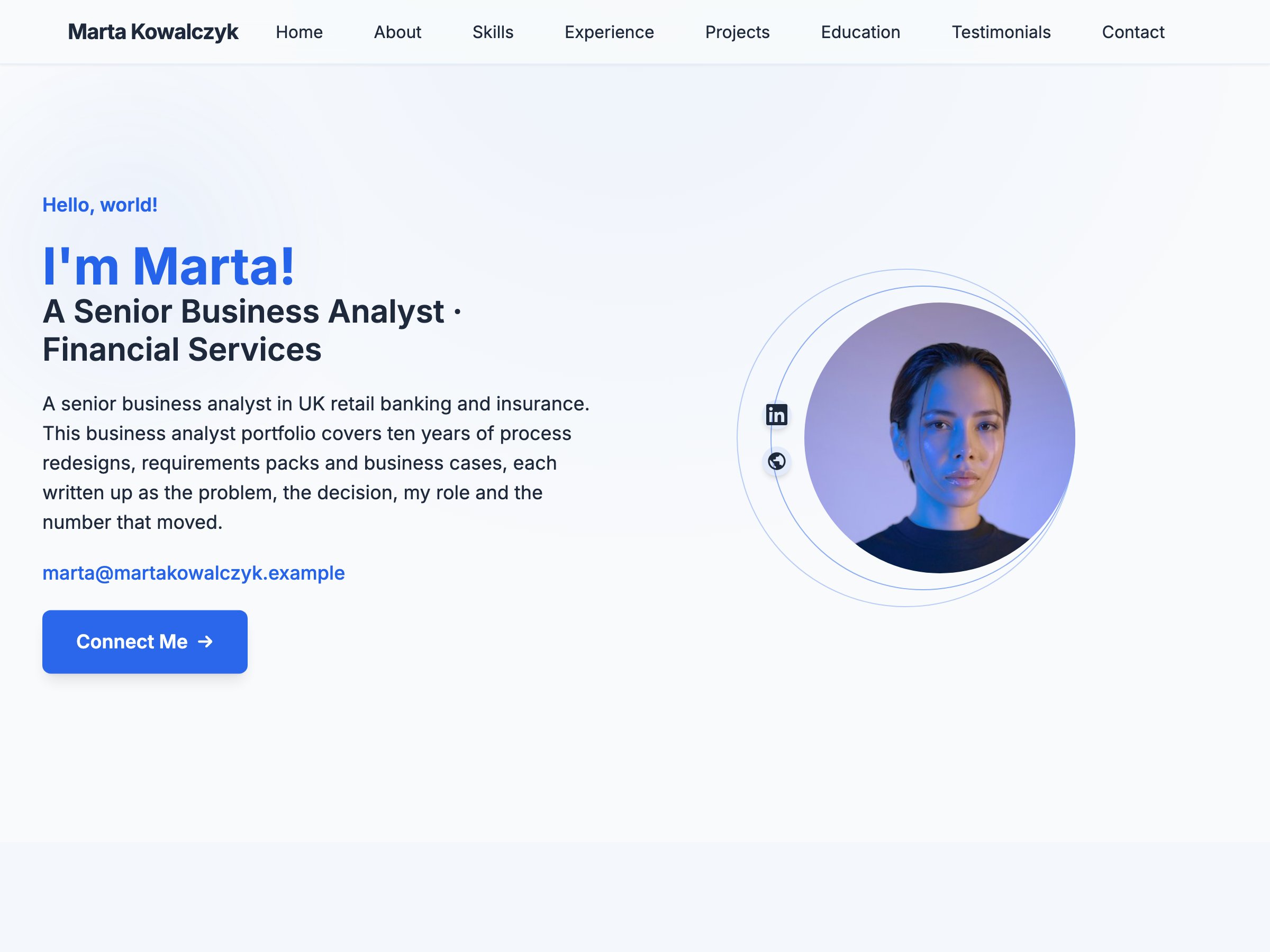
| Business analyst | Marta Kowalczyk (fictional sample, modeled on a common senior-BA career path) |
| Focus | Senior BA · financial services · payments, disputes and claims |
| Experience | 10 years: operations analyst → business analyst → senior BA |
| Location | London, UK — open to hybrid |
| Portfolio template | Professional — a light layout with room for long write-ups |
| Case studies | Process redesign · requirements baseline · business case · public requirements pack |
| Sections shown | Hero, About, Skills, Experience, four case studies, Education, Testimonials, Contact |
What a business analyst portfolio has to prove
A data analyst portfolio proves you can answer a question with data. A business analyst portfolio proves something different: that you can work out what the business actually needs, define a solution a team can build, justify it, and check that it worked. Unlike our product manager example, this page does not quote portfolio statistics, because we do not yet have enough business analyst portfolios on Seera to publish reliable numbers.
A useful yardstick is the BABOK Guide v3 from the International Institute of Business Analysis, which describes itself as the standard for the practice of business analysis and defines six knowledge areas. You do not need to name them in your portfolio, but readers who know the guide will recognize the coverage. Marta's four case studies touch all six:
| BABOK knowledge area | Where it shows in the portfolio |
|---|---|
| Business Analysis Planning and Monitoring | Planning six workshops across five teams and keeping a decision log |
| Elicitation and Collaboration | Front-line workshops and shadowing in the dispute redesign |
| Requirements Life Cycle Management | The traceability matrix and signed scope in the migration |
| Strategy Analysis | The four-option claims-intake business case |
| Requirements Analysis and Design Definition | As-is and to-be process maps, user stories and acceptance criteria |
| Solution Evaluation | Resolution time before and after, and the 12-month benefits review |
The practical lesson: a portfolio built from four copies of the same kind of project covers one or two of these areas. Four different kinds of work cover all of them.
Section-by-section breakdown of the business analyst portfolio
1. Hero: level, industry and promise in one line
"Senior Business Analyst · Financial Services" tells a hiring manager the level and the industry in six words. The bio underneath sets the contract for the page: every piece of work follows the same order of need, decision, role and result.
2. About: how you work, not where you grew up
This section starts with "I turn vague requests into decisions a delivery team can build and a steering committee can sign" and then backs it with habits: workshops with operations teams, process maps, requirements precise enough that a developer and a tester read them the same way, and a decision log on every programme. Every habit gives an interviewer something concrete to probe.
3. Skills: grouped by stage of the work
The skills are split into four groups: Elicitation & Stakeholders, Process & Analysis, Requirements & Delivery and Data & Business Case. Grouping by stage tells a reader how you work, which a flat list of twenty tools cannot. The tools earn their place only where they prove a capability: BPMN 2.0 shows you can model a process in the notation maintained by the Object Management Group, and SQL and Excel show you can size a problem without waiting in a data team's queue.
4. Case studies: four different kinds of analysis
This is the part of a business analyst portfolio that gets read before an interview. Marta's four case studies are deliberately different:
- A process redesign. Card disputes crossing three systems and four hand-offs. Six workshops produced an as-is map, and the fix was to remove a manual triage step rather than buy a case-management tool. Average resolution fell from 18 to 9 days.
- A requirements baseline. A legacy migration where every group listed everything as essential. 140 requirements were scored with MoSCoW, 96 made the must-have set, and post-UAT change requests ran 35% below the previous release.
- A business case. Four options for 11,000 re-keyed claims documents a month. The recommendation was to extend the tool already owned: £150k one-off against £420k annual savings, a seven-month payback, and 88% of the projected saving at the 12-month review.
- A public artifact. An anonymized requirements pack for claim-status notifications that anyone can open.
Four similar projects show you can repeat yourself. A redesign, a baseline, a business case and an artifact show that you can find the real problem, define what to build, justify the spend and measure the result. Breadth like that is what a screener is looking for.
5. Experience: one concrete result per role
Every role leads with its scope (five delivery teams across payments and disputes; claims-intake automation) and the outcome it is known for. The operations analyst role is brief, but it names the lesson: more than 40 hours of shadowing the people doing the work, which is where the habit of starting from the business need came from.
6. Testimonials: leadership, delivery and operations
Three voices, three angles. A programme director vouches for managing disagreement over scope, a lead developer for requirements that can be tested on day one, and a head of operations for an honest business case. Few business analyst portfolios include a developer or an operations voice, yet those two answer the question interviews keep circling: are you easy to work with?
7. Contact: one email and a dated availability line
Email, LinkedIn and a line reading "Open to senior / lead BA roles · Q1 2027". The date matters: it tells a recruiter whether to write now or wait, without an extra email.
How to write a business analyst case study
All four case studies here use one five-line template. Take it as it is:
Business need: who was affected and what the problem cost. One sentence, with a figure if you have one.
Options and decision: the options you considered, what was chosen, and what was rejected and why.
Your role: what you yourself were accountable for, separate from the team's work.
Outcome: what changed, over what period, and how it was measured.
What I would change: one honest sentence on what you would do differently.
The line most analysts skip is the rejected option. "Reduced handling time by 30%" could be anyone's result; "we compared four options and the one we already owned won" shows how you think. Aim for about 150 words per case study. Save the detail for the interview; the page just has to get you invited.
How to show business analysis work that is under NDA
Almost all business analysis is confidential, which is why so few analysts have anything to link. Four workarounds:
- Report ratios and ranges, not exact figures. "Resolution time halved" shows impact without disclosing volumes.
- Publish a sanitized artifact. A short requirements pack, a redrawn process map or a decision log with names and numbers removed, like Marta's claim-status pack.
- Map a public process. Pick a process anyone can observe, such as a returns policy or a booking flow, draw the as-is in BPMN, write ten user stories for an improvement and size the benefit.
- Get it checked. Read your employment contract, and if you are unsure, have a former manager look over the anonymized version before it goes live.
Business analyst portfolio mistakes to avoid
- Deliverables without decisions. A list of "requirements documents written" says nothing about what changed.
- "We" throughout. Name your own contribution; the testimonials are where the team gets its credit.
- A tool list as a skills section. Twenty logos prove familiarity, not analysis. Group by stage and keep the tools that prove something.
- Only wins. One honest miss, such as getting front-line agents into the workshops too late, reads as judgment.
- Nothing to click. A single public artifact is the cheapest differentiator you have.
Business analyst portfolio projects: six ideas if you have no client work
A business analyst can build portfolio projects from public processes, public services and a data question of their own. Each project below ends in an artifact a reader can open, which is the same test the four case studies on this page pass. Use public information only, and keep anything that belongs to an employer out of it.
| Project | What you produce | BABOK knowledge area it shows |
|---|---|---|
| Map a public service process, as-is and to-be | A BPMN diagram and a short list of pain points | Requirements Analysis and Design Definition |
| Write requirements for a feature a public app lacks | User stories with acceptance criteria and a MoSCoW priority list | Requirements Analysis and Design Definition |
| Build a business case for a change to a public service | An options table with cost, benefit and risk, and a recommendation | Strategy Analysis |
| Plan stakeholder interviews | An interview guide and a stakeholder map | Elicitation and Collaboration |
| Answer a stakeholder question with data | A SQL query and a one-page readout | Solution Evaluation |
| Write a UAT plan for a public website | Test cases, expected results and a defect log | Solution Evaluation |
Publish the artifacts as PDFs and link them from one portfolio page, with the five-line summary beside each. The NDA section above covers how to show work you did for an employer.
Business analyst portfolio PDF or website?
Use both: PDFs for the artifacts and a website as the index that links to them. A requirements pack, process map or business case is naturally a document, so keep each as a PDF a reader can open without a login. The website is the one link you put in every application and the place the five-line summaries live. Reserve GitHub for SQL files or diagrams kept as code, which most business analyst roles do not require.
How to build a business analyst portfolio like this
- Start by uploading your resume to Seera; the AI extracts your roles, projects and results.
- Choose the Professional template or look through the portfolio templates.
- Turn three or four projects into case studies using the five lines above.
- Include one document readers can open: an anonymized requirements pack, process map or decision log.
- Request a short quote of two sentences from a developer and an operations lead you have worked with.
- Go live on a free myseera.com address, or attach your own domain with Pro.
Frequently asked questions about business analyst portfolios
What should a business analyst portfolio include?
Start with a one-line statement of your level, industry and typical problem. Then add a short section on how you work, skills grouped by stage of analysis, three to five case studies (need, options, role, outcome, what you would change), one document a reader can open, a work history with a headline result per role, and quotes from delivery, operations and leadership.
Do business analysts need a portfolio?
Not always, and much of your work will be confidential. A portfolio earns its place when a resume alone cannot tell the story: you are crossing into analysis from operations or testing, going for a first BA role, or changing industries. For senior analysts it also works as rehearsed case material for interviews.
How many case studies should a business analyst portfolio have?
Three to five. Pick different kinds of work (a process redesign, a requirements baseline, a business case, an openable artifact) instead of four near-identical projects. Together they show you can find the problem, specify the fix, justify the spend and measure the result.
How do I show business analysis work that is under NDA?
Swap exact figures for ratios or ranges, strip customer and company names, and publish a sanitized artifact: a short requirements pack, a redrawn process map or a decision log. Read your employment contract first, and if you are unsure, ask a former manager to review the anonymized version.
Can I make a business analyst portfolio with no BA experience?
Yes. Lead with analysis you already did under another job title, such as a process you mapped in operations or acceptance criteria you wrote as a tester. Add one project of your own: map a public process, write ten user stories for an improvement and justify it. State the BA role you are aiming for.
What is the difference between a business analyst portfolio and a data analyst portfolio?
A data analyst portfolio proves you can answer a question with data: datasets, queries and dashboards. A business analyst portfolio proves you can define a problem and a solution: process maps, requirements, options and a business case. The two overlap at SQL and reporting, but the evidence is different.
What projects can a business analyst put in a portfolio?
Six that need no client work: a BPMN as-is and to-be map of a public service, a requirements pack for a feature a public app lacks, a business case for a change to a public service, an interview plan and stakeholder map, a SQL answer to a stakeholder question, and a UAT plan for a public website. Each ends in an artifact a reader can open.
Should a business analyst portfolio be a PDF?
Use PDFs for the artifacts, such as a requirements pack, process map or business case, and a website as the index that links to them. The website is the one link for every application; the PDFs let a reader open the work without a login.
Does a business analyst need GitHub?
Not for most roles. Use GitHub only for SQL files or diagrams kept as code. Requirements packs, process maps and business cases are documents, so publish them as PDFs and link them from your portfolio page.
Related business analyst portfolio resources
- Compare with: Data Analyst Portfolio Example
- Compare with: Product Manager Portfolio Example
- Compare with: Consultant Portfolio Example
- Forecasts and models rather than requirements? See a Financial Analyst Portfolio Example
- How to Build a Data Analyst Portfolio
- 8 Data Analyst Portfolio Projects That Get Interviews
- Professional template: the default layout
- Browse all portfolio templates