Portfolio Examples · Product Manager Portfolio
Product Manager Portfolio Example: Four Case Studies That Lead With Outcomes (2026)
A strong product manager portfolio is three to five case studies, each written as the problem, the decision you made, the outcome it produced and what you would change, plus at least one piece of work a hiring manager can actually open. This page takes a complete sample product manager portfolio built that way and breaks it down one section at a time, so you can reuse the structure for your own.
It is written for working PMs preparing a move, associate PMs going for their first full PM role, and analysts, business analysts and product owners moving into product management. The portfolio belongs to Amara Bello, a fictional senior PM in B2B SaaS: the profile and its metrics are a composite we wrote to show the pattern, not a real person's results. The template, layout and sections are exactly what you get when you publish on Seera's Professional template. For live portfolios by real product managers, see our gallery of four real product manager portfolios.
Key takeaways
- Open every case study with the problem and close it with a number.
- 91% of the 22 PM portfolios we analyzed already state a quantified result, so a number alone no longer stands out. The decision behind it does.
- Only 14% link to a project or artifact. One openable PRD, teardown or launch page puts you in the minority.
- Show range: a launch, an experiment, and a decision to stop building something.
- Group skills by how you work; list tools only where they prove you can get your own data.
View the Live Product Manager Portfolio →
The product manager portfolio at a glance
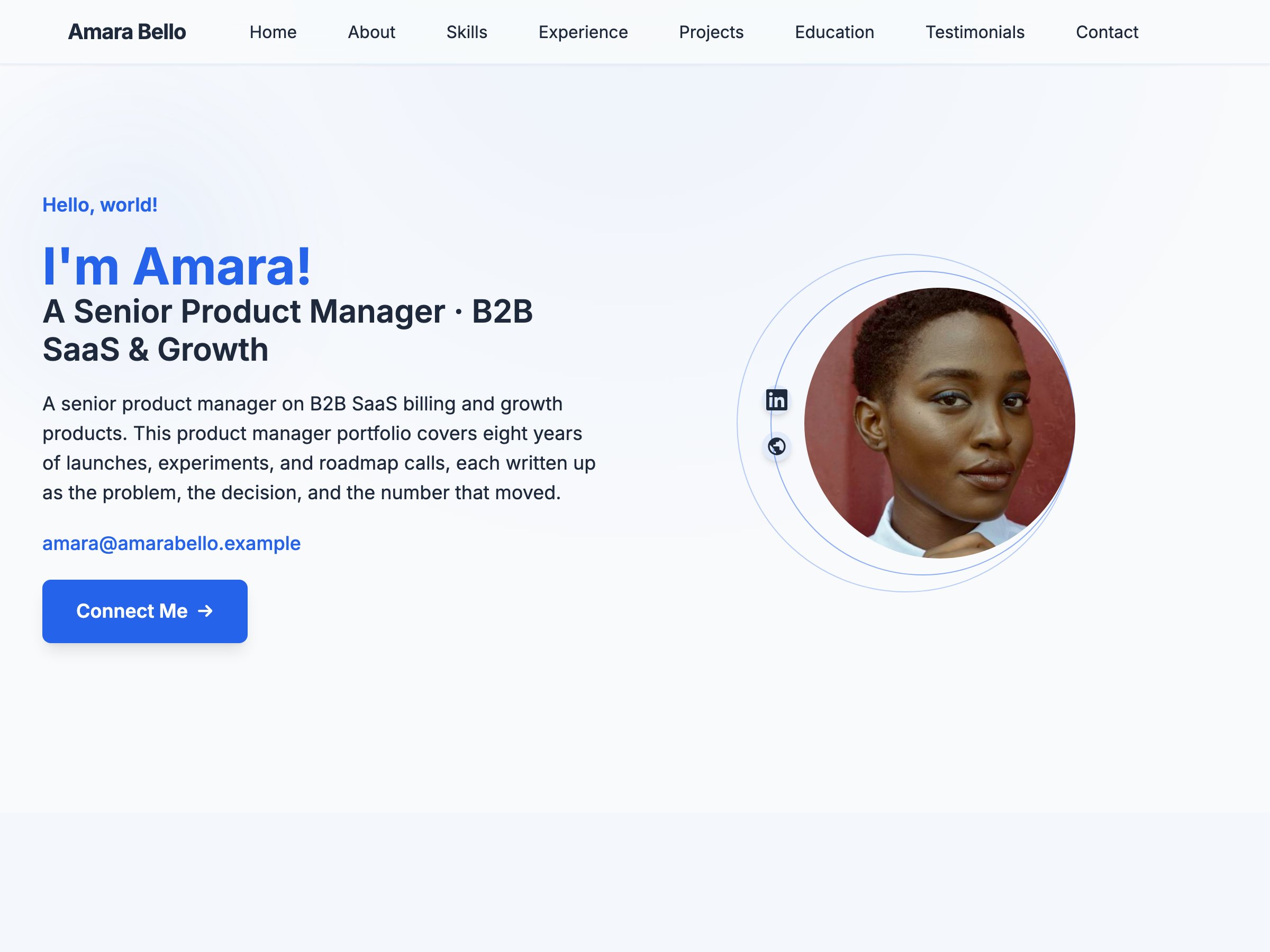
| Product manager | Amara Bello (fictional sample, modeled on a common senior-PM career path) |
| Focus | Senior PM · B2B SaaS · billing, pricing, onboarding and growth |
| Experience | 8 years: associate PM → PM → senior PM |
| Location | Denver, CO — open to remote (US) |
| Portfolio template | Professional — clean and light, built for text-heavy case studies |
| Case studies | 0→1 launch · A/B-tested activation · feature sunset · public PRD sample |
| Sections shown | Hero · About · Skills · Experience · 4 Case Studies · Education · Testimonials · Contact |
What 22 real product manager portfolios show
Before writing the sample, we looked at what product managers actually publish. Seera's product manager skill benchmarks aggregate 22 anonymized PM portfolios created on Seera. It is an early cohort, so treat the figures as directional.
| What the portfolio does | Share of PM portfolios |
|---|---|
| State at least one quantified result (%, $, ROI, conversion) | 91% |
| Link their LinkedIn profile | 95% |
| Reference roadmap work | 86% |
| Reference a launch or go-to-market | 77% |
| List no dedicated PM tool (Jira, Figma and the like) | 77% |
| Have a personal website | 32% |
| Link at least one project or artifact | 14% |
Source: Seera, Product Manager Skill Benchmarks 2026 (N=22; average 2.5 featured projects and 5.6 years of experience per portfolio).
Two conclusions shaped this example. First, a metric is now table stakes. When nine in ten portfolios quote a number, the number is not what separates you; the decision behind it, and a clear account of what you personally did, is.
Second, proof is scarce. About six in seven PM portfolios give a reader nothing to click. That is why Amara's fourth case study is a public, anonymized PRD rather than one more result.
Section-by-section breakdown of the product manager portfolio
1. Hero: level, domain and promise in one line
"Senior Product Manager · B2B SaaS & Growth" tells a hiring manager the level, the market and the kind of problem in six words. The bio underneath promises the format of everything below it: each project is written up as the problem, the decision and the number that moved.
2. About: how you make decisions, not your life story
The about section opens with "I own outcomes, not features" and then backs the claim with habits: customer calls, SQL, pre-mortems with engineering and design, a one-page brief before building and a readout after shipping. The line echoes Marty Cagan's distinction at Silicon Valley Product Group between teams measured by outcomes rather than output, and every habit it lists is something an interviewer can ask about.
3. Skills: grouped by how a PM works
The skills are split into four groups: Strategy & Discovery, Delivery & Launch, Data & Experimentation and Leadership & Communication. Most PM portfolios (77% in our data) list no dedicated PM tool at all, and that is mostly right; nobody hires a PM for knowing Jira. The exception is data. Amara lists SQL and Amplitude because they show she can pull her own numbers instead of waiting in an analyst's queue, and those are the numbers her case studies quote.
4. Case studies: four different kinds of product work
This is the part of a product manager portfolio that gets read before an interview loop. Amara's four case studies are deliberately different kinds of work:
- A 0→1 launch. Usage-based billing, rolled out to 40 design-partner accounts first, reaching 18% of new ARR within three quarters.
- An experiment. An onboarding redesign that cut setup from nine steps to four. It was tested in two A/B cycles across about 14,000 trial accounts, and week-1 activation rose from 31% to 42%.
- A decision to stop. Sunsetting a legacy reports module used weekly by only 6% of accounts. It freed three engineers, and churn in the affected cohort stayed within 0.4 points of baseline.
- A public artifact. An anonymized one-page PRD for self-serve team invites that anyone can open.
Four launches show you can ship. A launch, an experiment, a sunset and an openable artifact show that you can decide what to build, prove it worked, stop what is not working and write it all down. That range is what a hiring manager is screening for.
5. Experience: one concrete result per role
Each role opens with its scope (2,400 mid-market finance teams; self-serve onboarding for a product-analytics tool) and the result that defined it. The associate PM role is kept short but says what it taught: writing specs nobody could misread, learned from more than 60 clinic support calls.
6. Testimonials: leadership, engineering and design
Three voices, three angles. A VP of Product vouches for judgment on a pricing bet, an engineering lead for scope discipline, and a product designer for honesty about an experiment that missed. Engineering and design testimonials are the ones most PM portfolios lack, and they answer the question every PM interview circles back to: what are you like to build with?
7. Contact: one email and a dated availability line
An email address, LinkedIn and "Open to senior / group PM roles · Q1 2027". A dated availability line saves a recruiter one round-trip email.
How to write a product manager case study
Every case study in this example follows the same five lines. Copy the format:
Problem: who was stuck, and what it cost the business. One sentence, with a number if you have one.
Decision: what you chose to do, and the option you rejected.
Your role: what you personally owned, as distinct from the team.
Outcome: the metric that moved, over what period, measured how.
What I would change: one honest sentence.
Pick the outcome metric before you write. The HEART framework (happiness, engagement, adoption, retention, task success), introduced by Kerry Rodden, Hilary Hutchinson and Xin Fu of Google in a 2010 CHI paper on user-centered metrics, is a useful checklist. Amara's onboarding study reports an adoption metric, the billing launch a revenue metric, and the sunset is judged on retention.
Keep each case study to roughly 150 words on the page. The detail belongs in the interview; the page only has to earn it.
How to show product work that is under NDA
Most product work is confidential, which is the main reason so few PM portfolios link anything. Four ways around it:
- Use percentages and ranges instead of exact figures. "18% of new ARR" shows impact without disclosing revenue.
- Publish a sanitized artifact. A one-page brief or PRD with names and numbers removed, like Amara's team-invites PRD.
- Write a teardown of a public product. Pick a product anyone can use, name the problem you see, and lay out how you would size and test a fix.
- Check before you publish. Read your employment agreement and, if in doubt, ask a former manager to review the anonymized version.
Product manager portfolio mistakes to avoid
- Features without outcomes. "Shipped dashboards v2" says nothing about why it mattered.
- "We" everywhere. Say what you owned. The team gets credit in the testimonials.
- Twelve thin projects instead of four deep ones. The PM portfolios in our data average 2.5 projects; depth beats count.
- Only wins. One honest miss, such as Amara's first onboarding version that did not move the metric, reads as judgment.
- Nothing to open. See the 14% figure above. A single public artifact is the cheapest way to stand out.
Product manager portfolio template: what to put in it
A product manager portfolio template needs a one-line hero, three or four case studies in the five-line format (problem, decision, your role, outcome, what I would change), one public artifact, skills grouped by how a PM works, and testimonials from engineering and design. The five-line format is the part to copy exactly.
| Template block | What it holds | Where it is in this example |
|---|---|---|
| Hero | Level, domain and promise in one line | Section 1 |
| Skills | Grouped by how a PM works, not by tool | Section 3 |
| Case studies | Four, each in the five-line format | Section 4 |
| Experience | One concrete result per role | Section 5 |
| Testimonials | Leadership, engineering and design | Section 6 |
| Contact | One email and a dated availability line | Section 7 |
Is there a free product manager portfolio template? Seera's free plan publishes one template, Sovereign. The Professional layout used here sits on Pro at €4.99 a month billed yearly, though you can open and preview it first.
Product manager portfolio PDF or website?
Use a website as the source and a PDF as the attachment. A website gives recruiters one link to open and keeps your case studies current; a PDF suits an application portal that asks for a file or a short summary sent to one person.
| Format | Best for | Weak at |
|---|---|---|
| Website | One link in every application, current case studies, your own domain | Portals that only accept files |
| Attachments, offline review, sharing selected work under NDA | Going stale once sent; links inside it are easy to break | |
| Shared document or note page | Starting in an afternoon | Design, search visibility and a custom domain |
How to build a product manager portfolio like this
- Upload your resume to Seera. The AI pulls out your roles, launches and metrics.
- Pick the Professional template, or browse the other portfolio templates.
- Rewrite three or four projects in the five-line case-study format above.
- Add one public artifact: an anonymized PRD, a teardown or a launch page.
- Ask an engineer and a designer you worked with for a two-sentence testimonial.
- Publish on a free myseera.com address, or connect your own domain on Pro.
Frequently asked questions about product manager portfolios
What should a product manager portfolio include?
A one-line positioning statement (level, domain, kind of problem), an about section on how you make decisions, skills grouped by how you work, three to five case studies written as problem, decision, role, outcome and what you would change, at least one artifact a reader can open, work history with one result per role, and testimonials from engineering, design and leadership.
Do product managers need a portfolio?
Not every PM role asks for one. A portfolio helps most when your resume cannot carry the story: moving into product from analysis, engineering or design, applying for a first PM role, or switching domains. For senior PMs it doubles as prepared case material for interview loops.
How many case studies should a product manager portfolio have?
Three to five. The 22 PM portfolios in Seera's benchmark data feature 2.5 projects on average, so four well-written case studies already go deeper than most. Choose different kinds of work, such as a launch, an experiment and a decision to stop building something, over four similar launches.
How do I show product work that is under NDA?
Replace exact figures with percentages or ranges, remove customer and company names, and publish a sanitized artifact such as a one-page PRD or a teardown of a public product. Check your employment agreement first, and if in doubt, ask a former manager to review the anonymized version.
Can I make a product manager portfolio with no PM experience?
Yes. Lead with product work you did under another title, such as a process you redesigned as an analyst or a feature you scoped as an engineer. Add one teardown or side project with a written brief, and name the PM role you are targeting. The case-study format stays the same.
Which template works best for a product manager portfolio?
A clean, light template that keeps long case-study text readable. This example uses Professional, which gives case studies, experience and testimonials their own sections. PMs in design-heavy or AI products may want a bolder look, but the case studies matter far more than the template.
Is there a free product manager portfolio template?
Partly. Sovereign is the one template that goes live on Seera's free plan; the Professional layout in this example needs Pro. Either way the structure is six blocks: hero, skills, four case studies, experience, testimonials and contact.
Should a product manager portfolio be a PDF or a website?
Both, in different jobs. The website is the link you put in every application; the PDF is for portals that ask for a file. A PDF cannot be updated after it is sent and its links break easily.
Related product manager portfolio resources
- See 4 real product manager portfolios published on Seera
- Product Manager Portfolio Examples: 4 Real Ones, Scored
- Product Manager Skill Benchmarks 2026 (22 Portfolios)
- Compare with: Product Designer Portfolio Example
- Compare with: Data Analyst Portfolio Example
- Professional Template: See the Default Layout
- All Portfolio Templates (Free to Try)