Marketing Portfolio Examples That Win Interviews in 2026

A strong marketing portfolio is a handful of deep case studies, each built around a clear challenge, your specific actions, and a measurable business outcome. That format is what separates candidates who get callbacks from those who get politely ignored.
Here’s what that looks like in practice:
- Growth campaign: Inherited a paid search program with a $45 CPL. Restructured audience targeting and ad copy, ran multiple A/B tests over several weeks, and brought CPL down while doubling qualified lead volume.
- Content/SEO case: Audited a 200-page blog, consolidated thin content, and built 12 pillar pages. Organic traffic grew and, more importantly, content-sourced leads increased quarter over quarter.
- Product launch: Owned GTM for a new feature, coordinating paid, email, and in-app messaging. Activation rate among new users improved within the first 30 days post-launch.
Notice the pattern: context, your role, what you did, what moved. That’s the template.
Pro Tip: Myseera can auto-extract your projects and skills from a PDF or DOCX resume and generate a live portfolio website in seconds. You still need to add the narrative, but the structure is already there.

Table of Contents
- What hiring managers actually look for in your portfolio
- Role-specific marketing portfolio examples you can adapt
- How to convert your resume into an AI-generated portfolio
- How to write persuasive marketing case studies
- Design and presentation tips that make recruiter review fast
- Common portfolio mistakes and exactly how to fix them
- Key Takeaways
- The part most marketers get wrong about AI-generated portfolios
- Your resume is already a portfolio waiting to be published
- Useful sources and further reading
What hiring managers actually look for in your portfolio
Recruiters are not browsing your portfolio for inspiration. They’re scanning for evidence that you can connect marketing activity to business results.
Hiring managers prioritize pipeline, qualified leads, and revenue attribution over impressions, reach, or follower counts. If your portfolio leads with “reached 2M people,” you’ve already lost the room. Lead with what that reach produced.
Beyond metrics, they want to see full-funnel thinking. Did you understand the whole buyer journey, or just your slice of it? They also want to know what you personally owned. “Contributed to” is a red flag; “I owned the paid media strategy and ran the A/B tests” is not. Add the tools you used (HubSpot, Google Ads, GA4, Salesforce), the timeframe, and at least one artifact like a screenshot or anonymized dashboard. Those details reduce friction and build credibility fast. To go deeper on standing out to recruiters, Myseera’s guide covers the specifics.
Role-specific marketing portfolio examples you can adapt
Different roles call for different proof points. Use these as starting templates.
| Role | Core Metric to Lead With | Key Artifacts to Include |
|---|---|---|
| Growth Marketer | CPL, qualified leads, pipeline value | Ad dashboard screenshots, funnel charts |
| Content/SEO | Organic traffic growth, content-to-lead rate | GSC charts, before/after page rankings |
| Product Marketing | Activation rate, feature adoption, revenue impact | Launch timeline, in-app analytics |
| Social/Paid | CTR, CVR, cost-per-conversion | Creative samples, A/B test results |
| Demand Gen | MQL volume, pipeline sourced, conversion rate | Campaign reports, email performance data |
Growth marketer example: You ran a multi-channel demand gen program. Before: $78 CPL, 120 MQLs/month. After restructuring targeting and creative: CPL dropped, MQL volume climbed, and sales-accepted leads improved. Show the before/after with an anonymized dashboard screenshot.
Content/SEO example: You built a content cluster around a high-intent keyword category. Organic sessions grew, and more importantly, form fills from organic traffic increased. Include a Google Search Console chart and a before/after of the landing page.
Social/paid example: You ran a creative test across three ad variants. One outperformed the others on CTR and CVR. You scaled the winner, reduced cost-per-conversion, and validated the result over 30 days. Show the creative, the test setup, and the outcome.
For each case study, your checklist should cover:
- Company context and goal
- Your specific role and ownership
- The hypothesis you were testing
- Steps you took and tools you used
- Timeframe
- Measurable results (before/after or percentage delta)
Authory’s portfolio examples show how professionals structure these artifacts across integrated campaigns, which is a useful reference when you’re deciding what to include.
How to convert your resume into an AI-generated portfolio
This workflow takes under two hours from resume to recruiter-ready site.
- Prepare your resume file. Export as PDF or DOCX. Before uploading, identify your 3–5 strongest projects. For client work, note which numbers need anonymizing.
- Upload to Myseera. Myseera’s AI extracts your experiences, skills, and project snippets automatically. Choose a profession-specific template from the gallery that fits your role.
- Edit each auto-generated case study. The AI gives you a starting structure. Your job is to add the challenge, your hypothesis, the specific actions you owned, and the quantitative outcome. Anonymize sensitive figures by converting to percentages or ranges.
- Add artifacts and publish. Upload screenshots, dashboard exports, or campaign samples. Set a custom domain or use your Myseera live link. Enable built-in analytics so you can see when recruiters visit. Then publish and drop the link into your job applications and LinkedIn profile.
Time estimate: The draft site generates in seconds. Budget 30–90 minutes to polish three case studies to recruiter-level quality.
Pro Tip: Don’t wait until you have a “perfect” portfolio to share it. Publish a draft with two solid case studies, share the link, and keep editing. A live link beats a finished-someday portfolio every time.
How to write persuasive marketing case studies
The structure that works is simple: context, challenge, hypothesis, tactics, tools, timeframe, results.
Effective portfolios are structured narratives, not static file dumps. The difference is whether a hiring manager finishes reading and thinks “this person ran campaigns” or “this person solved a business problem.”
On metrics: prioritize revenue, qualified leads, conversion rate lift, cost per acquisition, and retention. Vanity stats like impressions belong in a footnote at best.
Before/after example — paid campaign:
- Before: “Managed Google Ads for a B2B SaaS client.”
- After: “Inherited a Google Ads account with a $92 CPL and no conversion tracking. Rebuilt campaign structure, added negative keywords, and set up GA4 conversion events. CPL dropped within 60 days; pipeline from paid search increased.”
Before/after example — SEO:
- Before: “Wrote blog content and improved organic traffic.”
- After: “Audited 150 blog posts, merged 40 thin pages, and built eight topic clusters targeting bottom-of-funnel keywords. Organic-sourced demo requests grew over the following quarter.”
When client confidentiality limits what you can share, anonymized percentage improvements and screenshots with redacted identifiers maintain credibility without breaking any agreements.
Design and presentation tips that make recruiter review fast
Your portfolio’s job is to get out of the way and let the work speak. These choices help.
Visual checklist:
- Responsive layout that works on a phone (many recruiters screen on mobile)
- Fast load time: compress images, avoid heavy embeds
- Clean hero section with your name, role, and one-line value proposition
- Each case study page has a clear headline, your role, and a results summary at the top
- Readable screenshots with annotations pointing to the metric that matters
- A contact CTA or resume download link on every page
SEO and sharing:
- Include your role keywords in the page headline and meta description
- Use a clean, readable URL slug (yourname.com/google-ads-case-study, not /project-4)
- Add the live link to your LinkedIn “Featured” section and every job application
| Element | Why It Matters | Quick Fix |
|---|---|---|
| Mobile responsiveness | Recruiters review on mobile during quick screens | Use a responsive template; test on your phone |
| Image compression | Slow pages lose viewers | Run images through Squoosh or TinyPNG |
| Analytics tracking | Know which pages recruiters visit | Enable Myseera built-in analytics or Google Analytics |
| Clean URL slug | Easier to share and remember | Edit slug in your portfolio settings |
Common portfolio mistakes and exactly how to fix them
Mistake 1: Vanity metrics as proof. Listing impressions, likes, or follower counts as your headline result signals you don’t understand business impact. Fix: convert every metric to a downstream outcome. Impressions become leads. Reach becomes pipeline. Followers become conversion rate on a campaign.
Mistake 2: Too many shallow projects. A portfolio with ten projects and no depth reads as a task list. Recruiters prefer three to five detailed, high-impact case studies that show ownership and results over a long gallery of thin entries.
Mistake 3: No artifacts or verification. Claims without evidence are just claims. Fix: include at least one screenshot, anonymized dashboard, or campaign sample per case study. Even a before/after of a landing page adds credibility.
Pro Tip: If you can’t share exact numbers due to an NDA, use percentage improvements and redact identifiers. “Reduced CPL by 34%” is more persuasive than a vague description, and it’s fully compliant.
Key Takeaways
A marketing portfolio built around three to five deep, business-impact case studies consistently outperforms longer, shallower collections in recruiter evaluation.
| Point | Details |
|---|---|
| Depth beats volume | Curate three to five case studies with clear ownership, tools, and measurable outcomes rather than listing every project. |
| Lead with business impact | Prioritize revenue, qualified leads, conversion rate lift, and cost per acquisition over impressions or follower counts. |
| Add artifacts | Include anonymized screenshots or dashboards for every case study to move beyond unverifiable claims. |
| Publish fast, then polish | A draft site generates in seconds with AI; budget 30–90 minutes to edit three case studies to recruiter-ready quality. |
| Myseera accelerates the workflow | Upload your resume to Myseera, auto-extract projects, choose a profession-specific template, and publish a live link to share with recruiters. |
The part most marketers get wrong about AI-generated portfolios
The speed argument for AI portfolio tools is real. Upload a resume, get a structured draft site in seconds, and spend your time editing rather than building from scratch. That’s a genuine productivity gain, and the 30–90 minute polish window is accurate for three solid case studies.
But here’s the caveat worth stating plainly: AI extracts what’s on your resume, and most resumes undersell the actual decisions you made. The draft will give you bullet points. It won’t give you the hypothesis you tested, the stakeholder pushback you navigated, or the trade-off you made between two campaign strategies. That context is what separates a portfolio that reads as strategic from one that reads as a task log.
The right workflow is AI for structure, you for substance. Let the tool handle the formatting and extraction. Then go back into every case study and add the thinking. What was the real problem? What did you try first that didn’t work? What would you do differently? Those answers are what hiring managers are actually looking for, and no AI can generate them from a resume bullet.
Your resume is already a portfolio waiting to be published
Most of the work is already done. Your resume contains the projects, the tools, the results. What it lacks is narrative structure and a live URL.
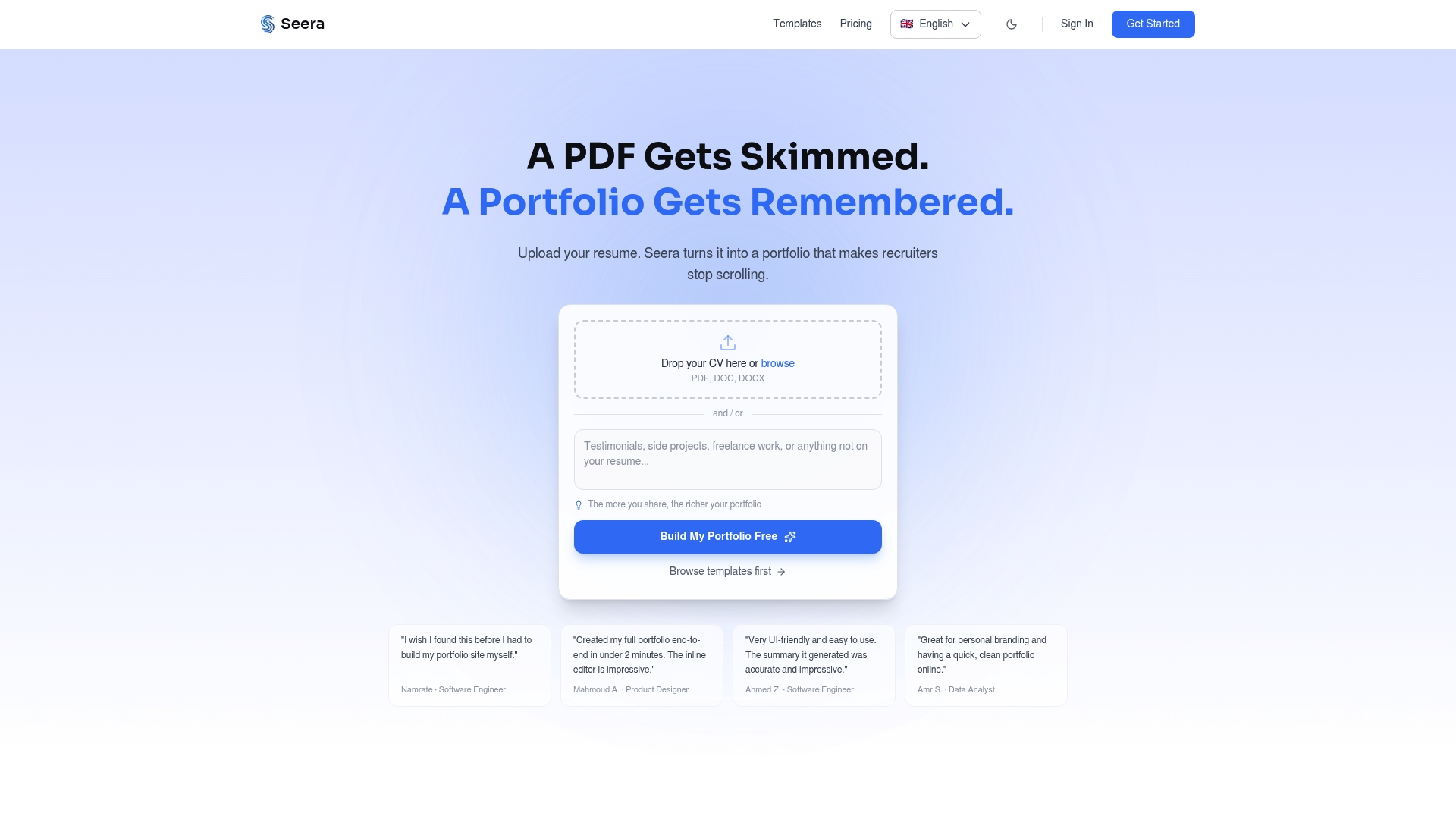
Myseera takes your existing resume (PDF or DOCX) and converts it into a professional portfolio website in seconds. The AI extracts your experiences, skills, and project highlights, then places them into a profession-specific template you can edit inline. No design skills needed, no starting from scratch. You get a live link you can share with recruiters today, a custom domain option for a polished personal brand, and built-in analytics so you can see exactly which pages get viewed.
The free plan covers basic publishing. The Pro plan adds custom domains, full analytics, and priority support. For students and early-career candidates, the free student portfolio builder is a fast starting point with no cost barrier.
Convert your resume now and have a live portfolio link ready before your next application.
Useful sources and further reading
- Katie Frank’s Marketing Portfolio — a strong real-world example of business-impact framing across paid, ABM, and demand gen
- Authory: 20 Digital Marketer Portfolio Examples — curated examples showing artifact types and narrative structure
- DigiTech Revolution: Digital Marketing Portfolio & Case Studies — practical guidance on anonymization, visuals, and case study depth
- Copyfol: 27 Marketing Portfolio Examples — broad collection showing how professionals across roles present their work
- Myseera Portfolio Templates — profession-specific designs for marketers, developers, and creatives
- Portfolio Website vs. LinkedIn Profile — guidance on where a live portfolio link adds the most value in a job search
Keeping your portfolio current: Schedule a quarterly review. Add any new campaigns with measurable results, retire outdated projects, and check your analytics to see which case studies recruiters spend the most time on. The pages with the highest dwell time tell you what’s working; the ones with quick exits tell you what needs a stronger headline or clearer results summary.
Recommended
- Why Marketers Need a Portfolio in 2026 (Not Just a Resume)
- How to Make Your Portfolio Stand Out to Recruiters — Seera
- Portfolio Website vs LinkedIn Profile: Which One Actually Gets You Hired?
- Seera Blog — AI Portfolio Builder Tips & Guides